
Untitled Samuel Delany Project #1 - The Jewels of Aptor (1962)
“How well do you know the machinery of a man, how he manages to function? That is what you will sing of if your songs are to become great.”

It begins with a girl, upset over a recording of a four-armed boy being tortured. She decides she’ll write a poem to get the image out of her head. Immediately before that, her mentor reminds her of an anecdote from the life of Cellini, that
“…at age four, he and his father saw the Fabulous Salamander on their hearth by the fire; and his father smacked the boy across the room into a rack of kettles, saying something to the effect that little Cellini was too young to remember the incident unless it was accompanied by pain.”
“I remember the story,” she said. “And I remember Cellini said he wasn’t sure if the smack was the reason he remembered the Salamander—or the Salamander the reason he remembered the smack!
“Perhaps when you stop seeing what they did so vividly,” the mentor goes on about the torture, “you will start seeing why they did it.”
Here it is: Samuel R. Delany’s first novel, The Jewels of Aptor, written when he was only 19 years old. It’s not as singular as his novels would go on to be, but here in the opening pages—as with the most carefully constructed novels—is kind of the whole thing. The body’s relationship to pain; the present’s relationship to the past; and the interrelationship between effects and causes, to the point that the question of extricating, of ordering them, hardly makes sense.
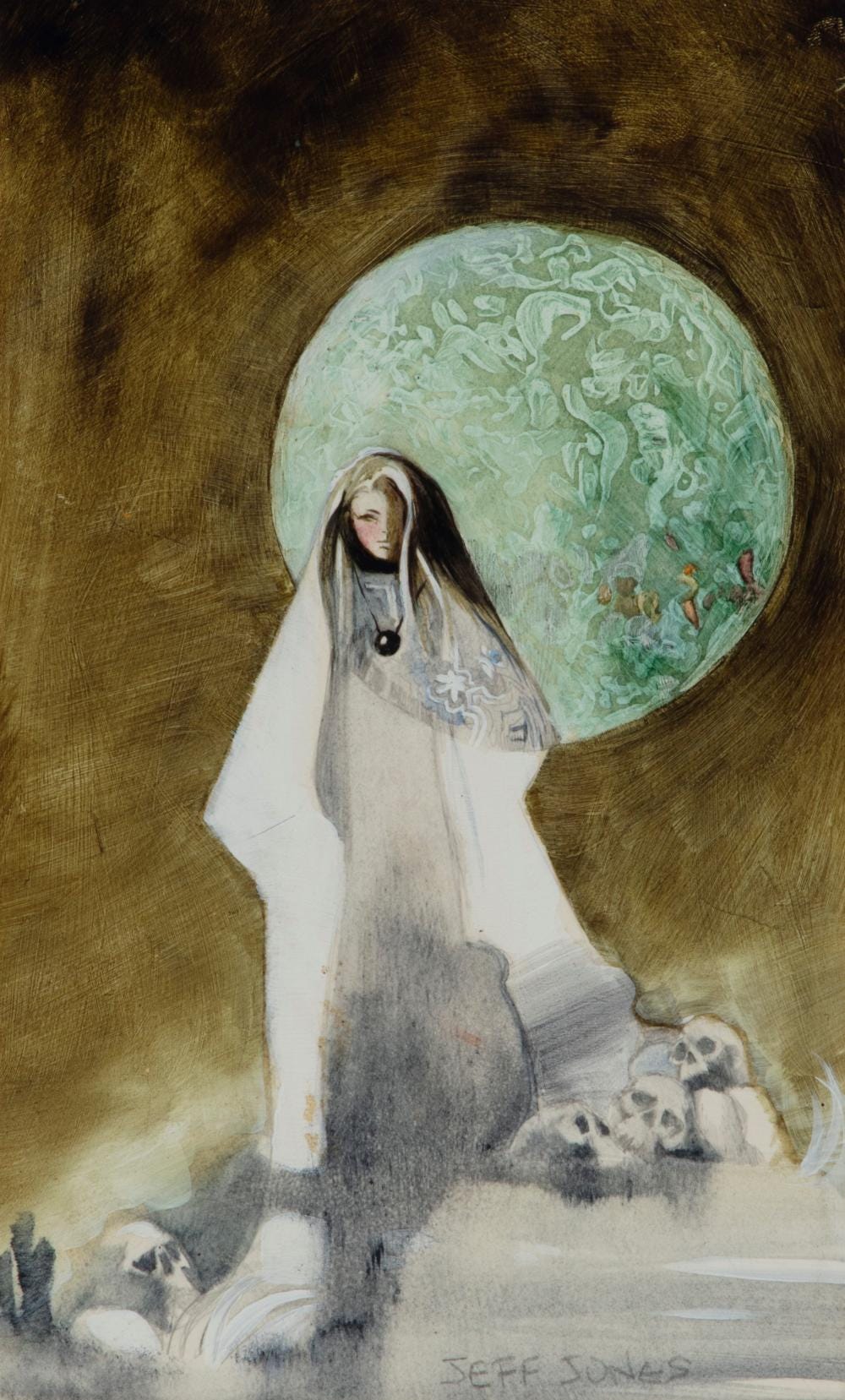
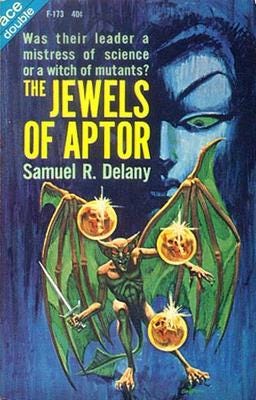
Jewels is the story of a burgeoning boy-poet named Geo, a disgraced sailor named Urson, and a mute/psychic four-armed boy name Snake, all of whom are tasked with retrieving near-mythic jewels from the land of, you guessed it, Aptor (the barbaric enemy nation of their homeland, Leptar) which worships the dark god Hama. They’re assigned this task by a priestess/earthly incarnation of the goddess Argo, whose daughter has also been kidnapped and taken to Aptor1. The jewels are small and white and convey the power to make fire or raze a city, to “fog the brain of a single person…or bewilder a hundred men.” Geo, Snake, and Urson join the crew of a ship Argo has chartered, and off they go.
So much of the book has the conventional trappings of a boys’ adventure novel: the high seas, a foiled murder in the middle of the night. When the three adventurers are thrown overboard by the ship’s treacherous first mate, they have to journey through the perils of Aptor to recover both Argo’s daughter and the jewels. From the outset you know, more or less, exactly what’s going to happen.
But as with any great genre literature, it’s the texture that makes a difference, and the texture is pure Delany.
From early on, it’s clear that the story is set in the distant aftermath of nuclear holocaust (what the characters call the “Great Fire”). Geo explains that five hundred years ago (a thousand years after the Great Fire) “all the rituals of the Goddess Argo were destroyed…All references to the earlier ones were destroyed, and with them, much of Leptar’s history. Stories have it that the rituals and incantations were too powerful.” Part of Geo’s charm and power is his desire for knowledge—including of these discarded rituals. He’s touched books that his teachers shied away from. He has memorized verses for calming bears, for courtly ritual, as well as for religious rite.
But Argo cautions him. When a story’s record is destroyed, that leaves room for new ignorance to creep in. “There are fifteen hundred years of retelling and distortion in a tradition never written down,” she says, “and perhaps Aptor has simply become a synonym for everything evil…all this [knowledge] has been assiduously kept from the people. For if it were made known, [the priestesses] would also have to reveal how staggering [their] ignorance.”
This is a book about knowledge—how it’s lost, preserved, and formed. In contrast to Delany’s formulation in The Jewel-Hinged Jaw that SF takes on the “practically incantatory task of naming nonexistent objects, then investing them with reality,” there are very few SF constructions here (no doors, to my recollection, dilate). The primary one is the titular “jewels”—a technology, verging on magic, that magnify energy. Instead there are conspicuous absences from the protagonists’ knowledge. “Electricity,” and “diode,” and “barracks” are all unfamiliar words to them. Technology and war deemed too dangerous to persist in the common tongue—repressed or forgotten.
Nevertheless, the past persists. Cellini appears in the opening pages, as does da Vinci. Later, Geo quotes “Change is neither merciful nor just/They say Leonard of Vinci put his trust/in faulty paints: Christ’s Supper turned to dust.”
Paint may fade2. Books can be burned, or torn to pieces. But what can be told can be carried3. It can be misremembered, and so transform, and that is as much its strength as it is its danger.
In their first meeting, the priestess Argo and Geo trade slightly different verses for the same discarded ritual. “Freeze the drop in the hand/and break the earth with singing./Hail the height of a man,/also the height of a woman./The eyes have imprisoned a vision…” quotes Argo. Geo’s version starts, “Burn the grain speck in the hand/and batter the stars with singing.” “Mine is the authentic one,” Argo insists after Geo claims the reverse. The important thing isn’t which one is correct; it’s that they are able to disagree. That the verse is still sufficiently alive that there can be two versions4.
Two more things that feel tied to this:
First, to reiterate: Snake is psychic. “Snake has seen into human minds,” Geo tells Urson. “He’s seen things directly that the rest of us learn only from a sort of secondhand observation.” More, he is able to show things to his fellow travellers that they would not otherwise have access to. They carry a level of objective truth that the memorized poetry and ritual don’t. Italicized visions arriving like a dream or prophecy—without intermediary5. I don’t 100% know how to square this with Geo’s living, protean verses. The information they bring is always plot-relevant, so maybe it is just a matter of how Delany chooses to tell the story. But for a book that is so much about not knowing, or being wrong, it is interesting that there should be a human antenna, beaming objective information to his friends.
Second—and this is probably the novel’s central idea—Jewels proposes an explanation for human behavior it calls the “double impulse.” When the heroes eventually meet Hama incarnate, he asks them why a man pulls his hand back from a fire.
“Because it burns,” says Urson. “Why else?”
“He also pulls it out because he knows that outside the fire his hand isn’t going to hurt,” Geo suggests. “Because the fire hurts, and because he wants it not to hurt.” It’s the second of these impulses that the jewels can interrupt (fogging the brain of a single person…or bewildering a hundred men), meaning that a man might hold his hand in the fire in terrible pain, but not knowing how to stop his hand from hurting.
“Yes, we can control minds,” Hama says, “but we do not.” It is impossible to use the jewels to any end but evil.
And if I am trying to reconcile all these pieces, as Jewels’ heroes try to reconcile various opposite pairs, maybe this is the key to it. There is safety in control, in eliminating the double impulse (when torturing Snake, Hama says, “we could have relieved the tiredness, immobilized the fear…but we would have also immobilized the…humanity he clung to.”). There is an ease to entering people’s minds as Snake does. But again—all he brings is information. No songs, no poems, no art.
There is what we do, and there is the understanding—instinctive or otherwise—that allows us to do it. Maybe these stand in for the Apollonian and Dionysian, the control and chaos needed to produce great art. We can be protected by what is forgotten just as easily as we can be harmed by it. (The jewels, by the way, are ultimately deemed too powerful to entrust to anyone but creatures living in the sea, who claim that the sea does not forget.)
It is the interplay of the living and the inert, the remembered and the forgotten—with all the contradictions—that is human. The two impulses, or more, that let us not only feel pain, but know what to do with it.
Next time on Untitled Samuel Delany Project, his 1963-1965 trilogy The Fall of the Towers. Also a reminder that my new book, All Us Saints, is out now! It is more or less like Jewels of Aptor if the ship was a house, the crew was a family, the jewels were cisness, and no one went anywhere.
The priestess technically stopped being the incarnation of Aptor when she had a daughter, but now that her daughter has been kidnapped, the title has reverted back. Like if being Jesus Christ was a heritable title.
The opening section also makes direct reference to the Mona Lisa, so it’s not like the book is claiming paint = bad, words = good.
If you’re the right kind of insufferable nerd, this might bring to mind the way that dissident Soviet poets passed certain verses, whispered to one another instead of written down.
I’m not even getting into it in the main text because it’s simply not that interesting, but we eventually learn—wow!—that Aptor isn’t actually evil, and the dark god Hama and the light god Argo are two sides of the same thing. Yin and yang are invoked. The thing that is evil is to have as much power as the jewels confer.
Sure, Snake is technically the medium here. But we are not seeing things that he himself has personally witnessed, nor are we having them narrated to us through him. The characters receive these visions in a narrative style that, apart from a slight lyrical elevation, is indistinct from the same way they see/hear/feel as they move through the world.
Hmm… I may need to read The Jewels of Aptor immediately…